Tesla Deploys Robotic Academy to Teach Humanoids Complex Tasks
Facing a lack of real-world data, Tesla is using a massive internal fleet of robots to train its new Optimus units for commercial release next year.
By Gabriela Flores ·
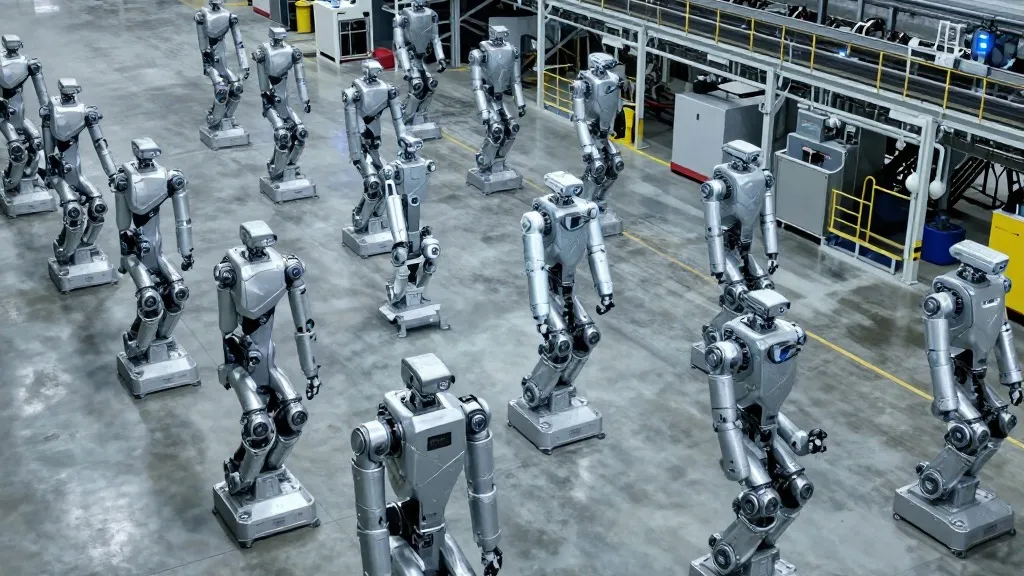
Tesla faces a critical hurdle in its push to mass-produce humanoid robots: unlike its cars, which rely on millions of vehicles to gather driving data, its new Optimus units lack a comparable fleet to learn from. To bridge this gap, the company has launched the Optimus Academy, a dedicated initiative where thousands of robots practice tasks to generate the training data necessary for commercial viability. This approach transforms the manufacturing line into a learning environment, addressing the core tension between limited real-world exposure and the need for advanced AI capabilities.
The physical infrastructure for this expansion is already in place. Tesla has converted the high-volume line in its Fremont factory, formerly used for Model S and Model X production, to build Optimus. The company cleared the old vehicle line in 46 days this spring to accommodate a robot production capacity sized for one million units annually. Elon Musk confirmed on Wednesday’s earnings call that most of the necessary equipment is already installed, with output expected to scale toward approximately 20,000 robots per week as the line ramps up. The company asserts that these early units are the first to meet production-quality standards suitable for a commercial product.
The training methodology relies on a self-improving loop. Within the Optimus Academy, an estimated 10,000 to 20,000 robots will perform a wide variety of tasks, feeding their experiences back into the system to refine the next model version. Every unit produced at Fremont serves as a source of this data. Musk described the growth trajectory as a classic S curve, noting that the initial phase will feature a shallow slope while the team refines the robot’s AI, electromechanical design, reliability, and service life.
Reactions from the executive team emphasize the shift toward genuine autonomy. Musk highlighted the difference between Optimus and rival humanoid demonstrations, which often rely on scripted routines. He indicated that a new video showcasing the robot completing tasks driven by AI rather than preprogrammed motions will be released within one or two months. Additionally, Tesla plans to integrate its AI5 chip into Optimus next year to enhance processing power, with the goal of delivering robots to outside companies by the end of next year for dangerous, repetitive, and around-the-clock work.
The supply chain is aligning to support this volume. In September, Tesla certified Tuopu, Joyson, and Sanhua as mass production partners for key components. Meanwhile, a significantly larger Optimus factory is under construction at Giga Texas, with recent drone footage showing the steel frame nearing completion. Musk has set a long-term target for that facility to produce 10 million robots per year. Executives noted that production costs are trending toward the manufacturing cost of the Cybercab, indicating the robot is engineered for volume from the outset, though the robotic hands remain the most challenging design element currently under engineering focus.
Source: Teslarati